Using a Long Line with Intention
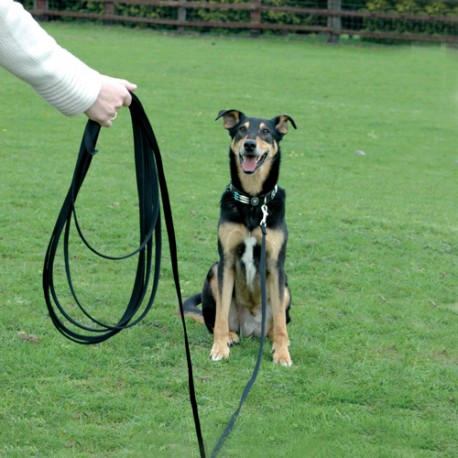
A long line can feel awkward the first time you use one. There is more rope in your hands and more space between you and your dog. That space is useful, but it works best when you introduce it thoughtfully.
Here are a few ways to make the transition feel steady instead of overwhelming.
Start Where Success Is Likely
Choose a place your dog already handles well. Inside your house. Your yard. A quiet country road. An open field where you can see clearly in every direction. Not a busy park or a place filled with sudden distractions.
The goal at first is not to test your dog. It is to let them experience the extra length without pressure.
Clip the long line on and simply walk. Let them move. Let them feel the difference. No new cues yet. No big expectations. Just calm movement together.
Add Distance in Layers
Do not let out the full length right away. Begin with just a few extra feet beyond your normal leash. When your dog stays responsive, let out a little more gradually. Slow and steady is the key here.
Distance changes the picture. It gives your dog more choice. By expanding gradually, you are teaching them that connection still matters even when space increases.
Keep Slack in the Line
A long line works best when it is not tight.
If the line stays under tension, it feels like a regular leash. Hold the handle securely in one hand and gather the extra line in loose loops with the other so it does not drag or tangle.
Slack gives your dog the opportunity to choose you. That choice is where reliability grows.
Mark the Choice
When your dog looks back at you. When they turn toward you. When they respond from a distance. That is the moment to say yes and reward.
Do not wait until they are standing beside you. Acknowledge the decision when it happens. That timing helps your dog understand exactly what earned the reward.
Keep Expectations Realistic
A long line is a bridge. It is not immediate off leash freedom.
Use it to practice recall. Reinforce check ins. Build comfort at a distance. If your dog struggles, shorten the space and reset. That is information, not failure.
The goal is steady growth, not perfect performance.
A Note About Retractable Leashes
Retractable leashes are not the same as long lines, and they are not a safe substitute.
Retractable leashes rely on thin cords or tape that stay under constant tension. Those cords can snap or cause rope burns if your dog pulls suddenly. The internal mechanism can fail without warning, which may allow your dog to run into the street or toward another dog unexpectedly.
If the cord wraps around a hand, leg, or another person during a sudden movement, it can cause injury. Because the leash is always tight, dogs also learn to pull into pressure rather than move thoughtfully with you.
A proper long line uses a thicker, static line with a secure handle. It provides steady communication and reliable feedback without the mechanical risks.
If your goal is training, clarity, and safety for everyone around you, a long line is the more responsible choice.
Used intentionally, a long line does not mean losing control.
It means you are ready to help your dog grow into the next level of responsibility, one thoughtful layer at a time.